Week 8
As a 34-year-old UCLA architecture student and mother of two, I know the meaning of balance between a life of structure and spontaneity. My journey from China to the United States, coupled with my military service, has put me in a unique position among many—introducing me to worlds that lie at the intersection of technology, medicine, and art. This week, I could understand medical technologies with the help of the view from different artist projects, and this helped me get a better understanding and appreciation of these advances.
One of the materials that were most potent in what I went through today was the "Inner Worlds: Art in the Age of Nanotechnology" talk by Honor Harger at the INL Summit. For example, Monika Lelonek and Jenna Wies, whose projects "Nano Grand Canyon" and "Die Wueste erwacht," respectively, are among the artists mentioned by Harger who work with nanotechnology. Very involving, they show invisible processes on a molecular level vividly and provide the missing links for scientific hypotheses in visual art.

Lelonek, Monika. "Nano Grand Canyon." Nano4Women Nano & Art Awards.
During this study, I also stumbled upon the technique of DNA origami by Paul Rothemund, through which molecular programming can be used to fold complex structures at the nano-scale level. The method has made significant progress in medical technology because it not only allows doctors to use DNA as a material and its molecules can be arranged as and when required but also promises new potential in architectural design at the molecular level. The way form and function are balanced in DNA origami is what echoes equally to the architecture that I'm studying in principle (Rothemund, 2006).

Rothemund, Paul. "Folding DNA to Create Nanoscale Shapes and Patterns." Nature, 2006.
Victoria Vesna and James Gimzewski undertook another notable work on the artistic representation of nanotechnology for the exhibition "NANO" at the Los Angeles Museum of Contemporary Art. It displayed the highly interdisciplinary approaches to understanding and visualizing issues in molecular science. Vesna & Gimzewski, 2004. Vesna, Victoria, and James Gimzewski.

"NANO." Los Angeles Museum of Contemporary Art, 2004.
Another influential piece was the "Glass Microbiology" series by Luke Jerram. His glass renditions of viruses and bacteria point to the visual beauty of the microscopic world and provide a pungent reminder of the complex relationship between humankind and pathogens. Jerram's work suggests that an awareness of this kind be served aesthetically and educationally as medical science-linked art (Jerram, 2014).
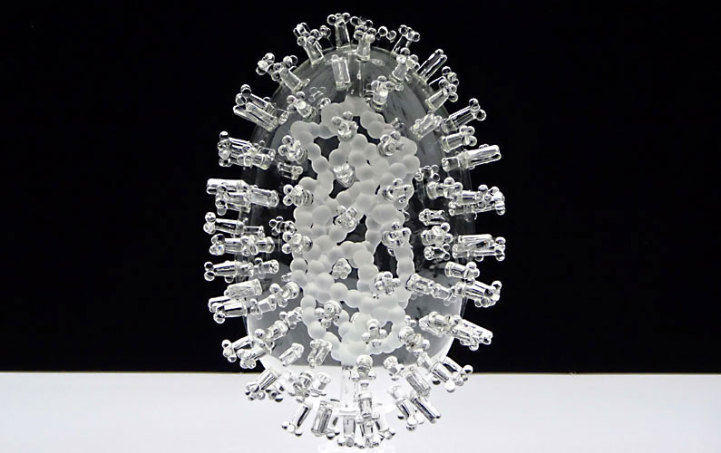
Jerram, Luke. "Glass Microbiology." 2014.
Additionally, I explored "Projections of a Perfect Third" by Conrad Shawcross, an installation that uses light and motion to explore the geometry of the universe. This work, exhibited at the ArtScience Museum in Singapore, pushes the boundaries of how we perceive scientific concepts through art (Shawcross, 2014).

These studies have highly resulted in my epiphany regarding the dual role that medical technologies can play: function and inspiration. The amalgamation of art and science extends our ability to interpret complex, highly detailed biological procedures while making way for architectural innovations. And I am so excited to continue applying these insights of interdisciplinary learning in design that should not just work structurally soundly, but make sense on a deeper and more intuitive level.
References
- Harger, Honor. "Inner Worlds: Art in the Age of Nanotechnology." INL Summit, 2017, https://www.summit2017.inl.int.
- Rothemund, Paul. "Folding DNA to Create Nanoscale Shapes and Patterns." Nature, 2006, https://www.nature.com/articles/nature04586.
- Vesna, Victoria, and James Gimzewski. "NANO." Los Angeles Museum of Contemporary Art, 2004, https://nano.arts.ucla.edu/mandala/about.php.
- Jerram, Luke. "Glass Microbiology." 2014, https://www.lukejerram.com/projects/glass_microbiology.
- Shawcross, Conrad. "Projections of a Perfect Third." ArtScience Museum, 2014, https://www.marinabaysands.com/museum/exhibition-archive/the-universe-and-art.html.
Comments
Post a Comment